Method for Digital Innovation Thesis
Lemme Digital Growth
A framework that equips creative professionals to lead digital business innovation.
- Timeline
- Sep 2021 to Mar 2022
- Role
- Solo project
- Published in
- Design 5.0

Overview
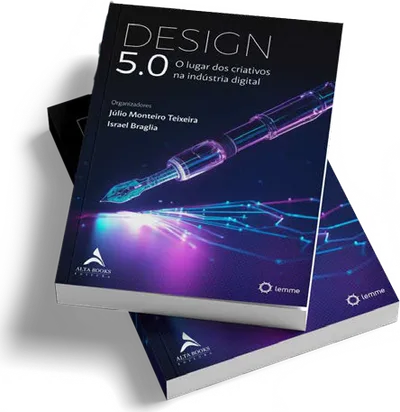
Originally developed as my graduation thesis and later published in the book Design 5.0: the role of creatives in the digital industry, Lemme Digital Growth (LDG) is a framework that equips creative professionals to lead digital business innovation.
Structured in three stages (Lemme, Digital, Growth), it provides a step-by-step guide, toolbox of methods, and real case studies to support independent decision-making, data-driven strategies, and continuous improvement across diverse project types.
This project aimed to formalise the approach as a method by materialising the tool, making it easier for professionals and students to understand and apply it.
Responsibilities
This was a solo project. I was responsible for analysing documents, structuring, conducting and categorising expert interviews, developing the final artefacts and the final thesis. I could also count on my supervisors, turning to them for guidance and information.
Impact
This was the first formalisation of LDG as a method for academic and professional context. It became a foundational reference in the Lemme Lab and was adopted in academic courses (e.g. Design UFSC) and applied to several consulting projects.
Team
- Gabriel Albrecht (me)
- Prof. Dr. Júlio Monteiro Teixeira (Supervisor)
- Profª. Juliana Krupahtz (Co-supervisor)
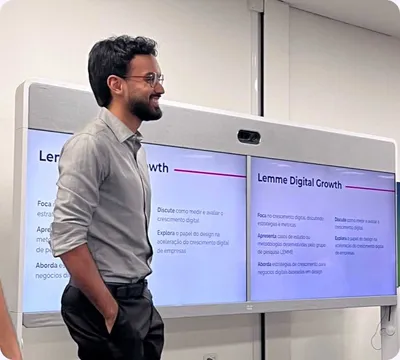
Gabriel quickly understood the challenges of representing this method and approached them with maturity, thinking not only as a designer, but also as a researcher.
Design Method
This work merges a practical approach, guided by Teixeira’s roadmap for creating visual models, with an academic perspective to establish the theoretical foundation of the project.
-
01
Research
Document Analysis → Literature Review → Interviews
-
02
Ideation
Stage Mapping → Visual References
-
03
Implementation
Visual Representation → LDG Toolbox → Book Chapter
Briefing
Briefing & Document Analysis
Lemme Digital Growth (LDG) was originally an informal design method used in consulting and teaching by the Lemme Lab at UFSC. Despite its growing adoption, the method lacked visual consistency, clear guidelines, and conceptual standardisation. This made it oftentimes hard to apply without prior mentorship.
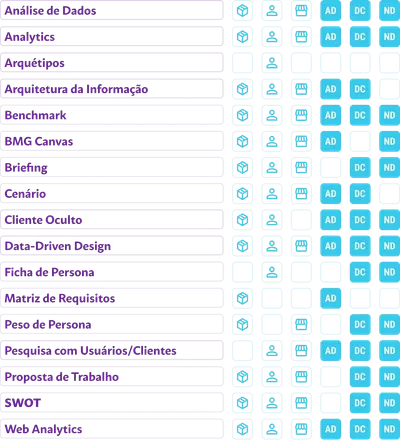
To kick off the project, I reviewed the documents that facilitated the current LDG implementation, including: lesson plan for the digital innovation project; checklist of deliverables for each phase; and a spreadsheet with all the tools that fit into the method, which I reorganised to enhance the data structure for the tools.
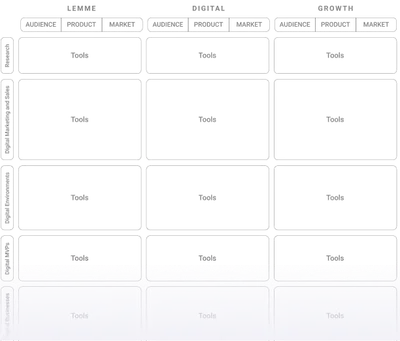
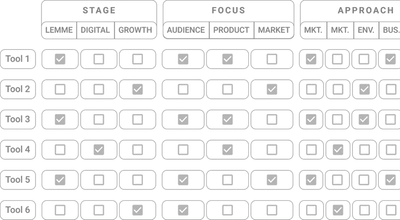
Similar to a database, the new structure allows for easy filtering, useful to understand correlations between tools and their recommended stages, focus and approaches.
01 · Research
Literature Review
The goal of the literature review was to provide a global perspective on themes related to the LDG approach. To that end, it explored two main areas (Project Management and Design for Digital Innovation) and their related topics.
By referencing both foundational publications (PMI, Agile Alliance, Teixeira) and more recent contributions, such as Kotler, Kartajaya, Setiawan, and Trabucchi & Buganza from Politecnico di Milano, the review enabled an overview of design within the context of digital innovation.
Visual Project Management
Involves a set of actions and tools for enhancing the visibility of the project development process.
Design for Digital Innovation
Promotes new services or processes using digital technologies, prioritising human needs and addressing the demands of different audiences.
Interviews
The research phase included semi-structured interviews with the framework’s creators. These interviews helped to achieve a comprehensive understanding of the method’s strategic intent and validate the logical structure of its three stages. This ensured the visual representation accurately reflected the LDG philosophy.
Each of the interviewed specialists represented a stage of the framework and a project focus, as follows:
- Lemme & Digital Environments
- Digital & Content Design
- Growth & Digital Business
After the interviews, a structured summary of the key points was organised by relevant topics and in order of occurrence. The main findings are outlined below:
Strengths
- Modularity for application across project types
- Adaptability to various demands and areas
- Successful use cases in academia and market
- Provides learning, autonomy, and experience
Weaknesses
- Lack of documentation, guides, and examples
- No visual representation that structures LDG
- Not self-explanatory for those unfamiliar
- Can leave inexperienced designers confused
Other outcomes
- Conceptualisation of each stage by the respective specialist
- Definition of deliverables for each stage and focus
Overall, the interviews reinforced the importance of complementing the framework with visual support, clearer guidance, and aligned deliverables to improve adoption among designers.
02 · Ideation
Stage Mapping
Stage Mapping (Quadro de Etapas) consisted of converting the LDG’s textual conceptualisation into a clear, sequential visual structure. The method was proposed as a continuous improvement cycle, segmented by the three macro-stages. This detailed mapping served as the blueprint for the final representation.
Lemme
ImmersionDefine a project direction after understanding the client's context through three aspects: product, audience, and market.
- Product
- Understanding the product
- Audience
- Audience and persona analysis
- Market
- Market analysis and positioning
Digital
IdeationGenerate ideas for digital solutions that meet project objectives, select the most promising ones, and prepare for implementation (prototyping).
- Product
- Content design
- Audience
- Sales journeys and funnels
- Market
- Digital marketing strategies
Growth
ImplementationApplication of digital solutions in real situations. Measurement of the impact of applied solutions. Preparation for a cycle of continuous improvement.
- Product
- Version 1.0: project's product
- Audience
- Interaction with the audience and metrics
- Market
- Action plan: short, medium, and long term
Initially, all the tools were a part of the framework. Due to technical constraints, they were structured as a separate tool (LDG Toolbox).
Visual References
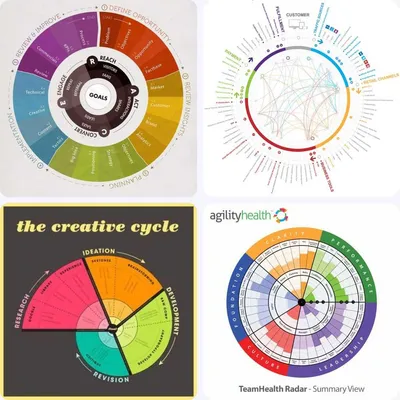
With the informational structure defined, I searched for visual references from similar frameworks. Key ideas adopted included:
- Use of colours to differentiate the levels within each stage
- Arrows connecting each stage, indicating the order of reading
- Cyclical format, emphasising the continuous improvement flow
03 · Implementation
Visual Representation
To support adoption and scalability, the framework required a visual structure that could clearly communicate its stages and approach to other creative professionals. Sketches were first explored manually and later refined digitally using Adobe Illustrator.
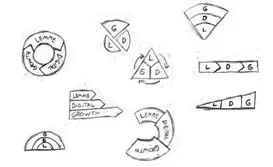
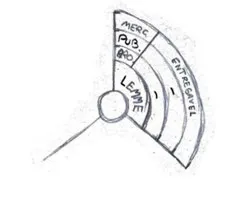
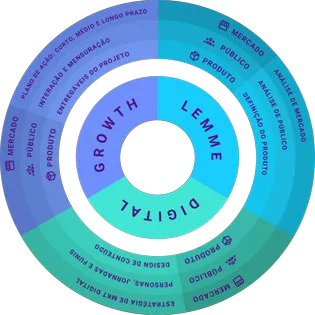
From many explored ideas, this is the evolution of the chosen version for the representation.
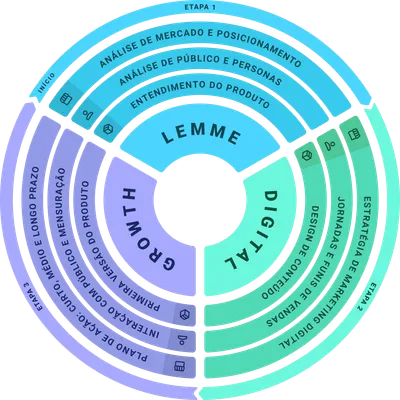
After testing different structures, a circular format was chosen for best representing LDG’s cyclical nature. The final version separates project stages by colours, and orders focuses (product, audience, and market) from the inside out, advocating for an intrinsic understanding of the company to then gradually preparing the product for market acceptance.
LDG Toolbox
The LDG Toolbox works as a catalogue, where all the relevant tools are listed and categorised by stage, focus and project type.

Book Chapter
Recently, I co-authored a chapter about LDG in the book Design 5.0: The Role of Creatives in the Digital Industry. We have included practical use cases that exemplify design innovation and autonomous decision-making on tool choosing.